

Chainlink Runtime Environment Now Live, Unlocking the Full Capabilities of Onchain Finance


- Chainlink Runtime Environment Now Live, Unlocking the Full Capabilities of Onchain Finance
- Smart Contracts Are Becoming Increasingly More Advanced
- CRE: The Orchestration Layer of Onchain Finance
- Institutional Use Cases Being Built on CRE Today
- Developers Can Get Started In Minutes
- The Next Chapter for CRE and Onchain Finance
- Start Building With CRE Today
We’re excited to announce the launch of the Chainlink Runtime Environment (CRE), the all-in-one orchestration layer unlocking institutional-grade smart contracts for onchain finance.
Prior to the launch of the Ethereum Virtual Machine (EVM), smart contract development was highly complex given the limited programmability of blockchains. In 2015, the EVM transformed blockchains by introducing a programmable execution environment for smart contract code on a single blockchain. This greatly simplified smart contract development by enabling developers to write their own smart contracts on a single chain, using only the data and tokens within that chain. It was a critical moment that introduced single chain tokenization, onchain trading, onchain voting, and many other types of smart contracts, transforming our industry from a few billion dollars to several trillion today.
Since then, smart contracts have dramatically increased in complexity and scope in what they are required to do, now requiring additional infrastructure that connects the offchain world with the onchain world, which the EVM and blockchain execution environments in general are not able to solve. This challenge is known as “the oracle problem”, and the Chainlink community is widely credited for solving it. The oracle problem of needing to connect to external systems is becoming even greater with institutional adoption, as advanced institutional use cases require access to external data, cross-chain interoperability, and identity and compliance solutions to go live, as well as connectivity to their permanent existing systems for accounting and management of value—ranging from core banking infrastructure to payment networks such as Swift. Until now, there has not been a single, secure, and efficient way to meet the requirements of institutions and manage all this complexity without relying on a growing list of individual integrations.
The launch of CRE today marks the start of a new era in smart contract software development. CRE provides an all-in-one orchestration layer for building end-to-end institutional-grade smart contracts—smart contracts that are easily connected to external data, cross-chain enabled, compliance-ready, and privacy-preserving, which are able to securely interoperate across thousands of public and private blockchains, existing identity systems, and core financial infrastructure. This is the next major technological leap needed to bring the global financial system onchain at scale and propel our industry from a few trillion dollars in value to hundreds of trillions.

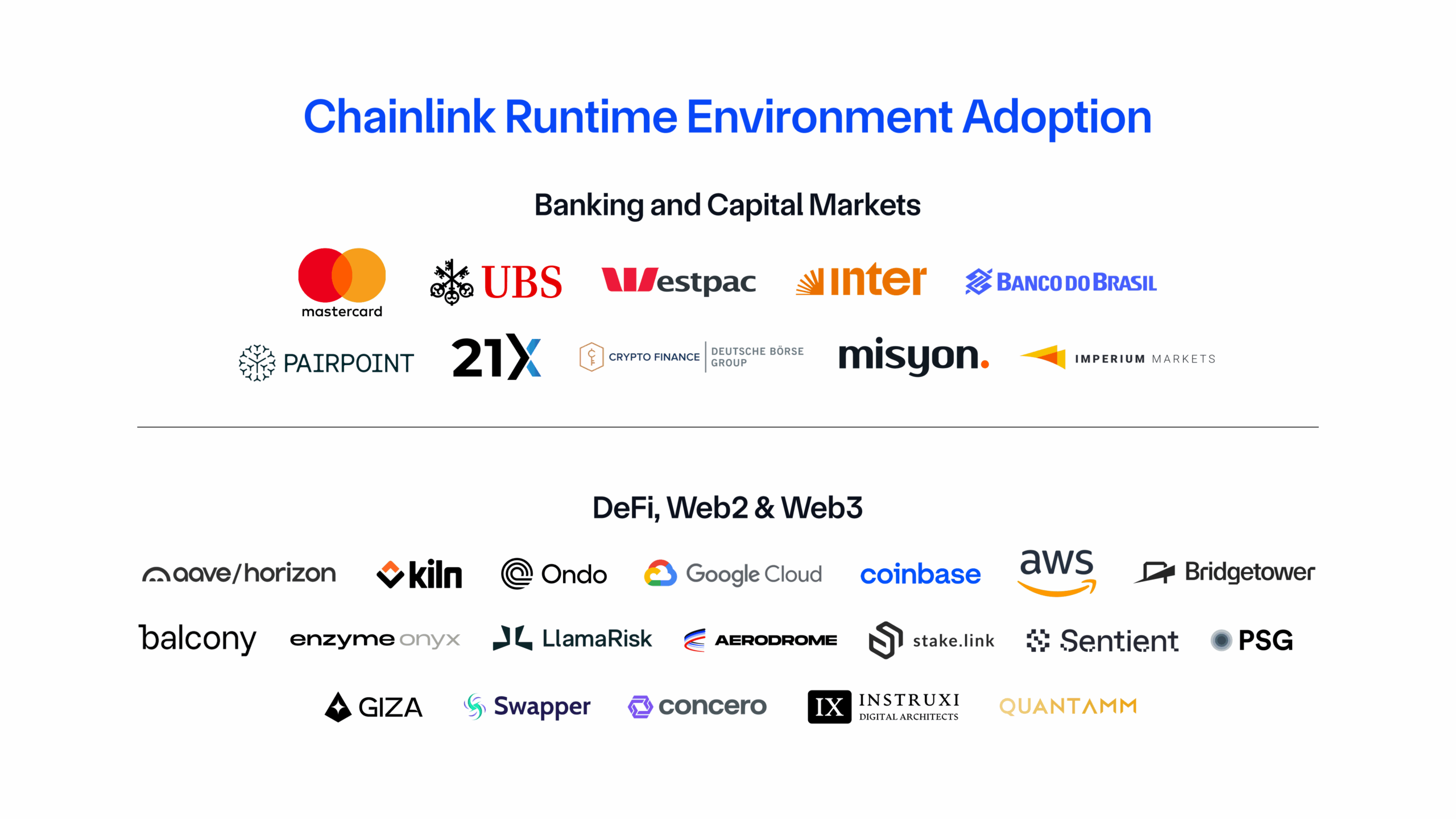
From stablecoins and tokenized real-world assets to Delivery vs. Payment (DvP) settlement and onchain data distribution, a wide variety of more advanced onchain finance use cases are already being built and deployed on CRE today by leading institutions, Web2 enterprises, and Web3 protocols, including:
- Kinexys by J.P. Morgan and Ondo used CRE to conduct a first-of-its-kind cross-chain DvP transaction between public and private blockchains.
- Swift, Euroclear, and 22 leading financial market participants are part of an industry initiative using CRE to streamline corporate actions processing.
- UBS Tokenize and DigiFT completed the first-ever redemption of a tokenized fund using the Chainlink Digital Transfer Agency (DTA) technical standard powered by CRE.
- Swift and UBS are leveraging CRE to manage tokenized fund workflows using the existing ISO 20022 messaging standard.
- Mastercard and Swapper co-developed a payments solution on CRE that enables Mastercard’s 3.5 billion credit card holders to purchase crypto assets on decentralized exchanges, such as Uniswap.
- Westpac Institutional Bank and Imperium Markets are implementing CRE in Project Acacia, a new joint initiative between the Reserve Bank of Australia and Digital Finance CRC (DFCRC), to orchestrate DvP settlement of tokenized assets.
- Banco Inter, Hong Kong Monetary Authority (HKMA), the Central Bank of Brazil (Banco Central do Brasil), Standard Chartered, and additional partners launched a blockchain-powered trade finance platform that leverages CRE to securely automate settlement of cross-border agricultural trade.
- Coinbase’s x402 standard is enabling AI agents to pay for CRE workflows.
- Six other leading platforms are also leveraging CRE for AI-powered workflows, including Sentient, Giza, ChaosChain, CodecFlow, ampli^, and ElizaOS. CRE helps these AI apps access data, trigger agent logic, connect across systems, support secure guardrails, and much more.
- Google Cloud and Amazon Web Services (AWS) are collaborating with Chainlink to showcase how CRE can connect to Web2 systems.
- Balcony, the leading platform for real estate tokenization backed by government-sourced data, is adopting CRE to power $240+ billion in property assets onchain.
- 21X, the first EU-regulated onchain exchange for tokenized securities, adopted CRE in production to power its exchange with verifiable post-trade data, including last traded prices and bid-ask offers, for securities listed on the 21X platform.
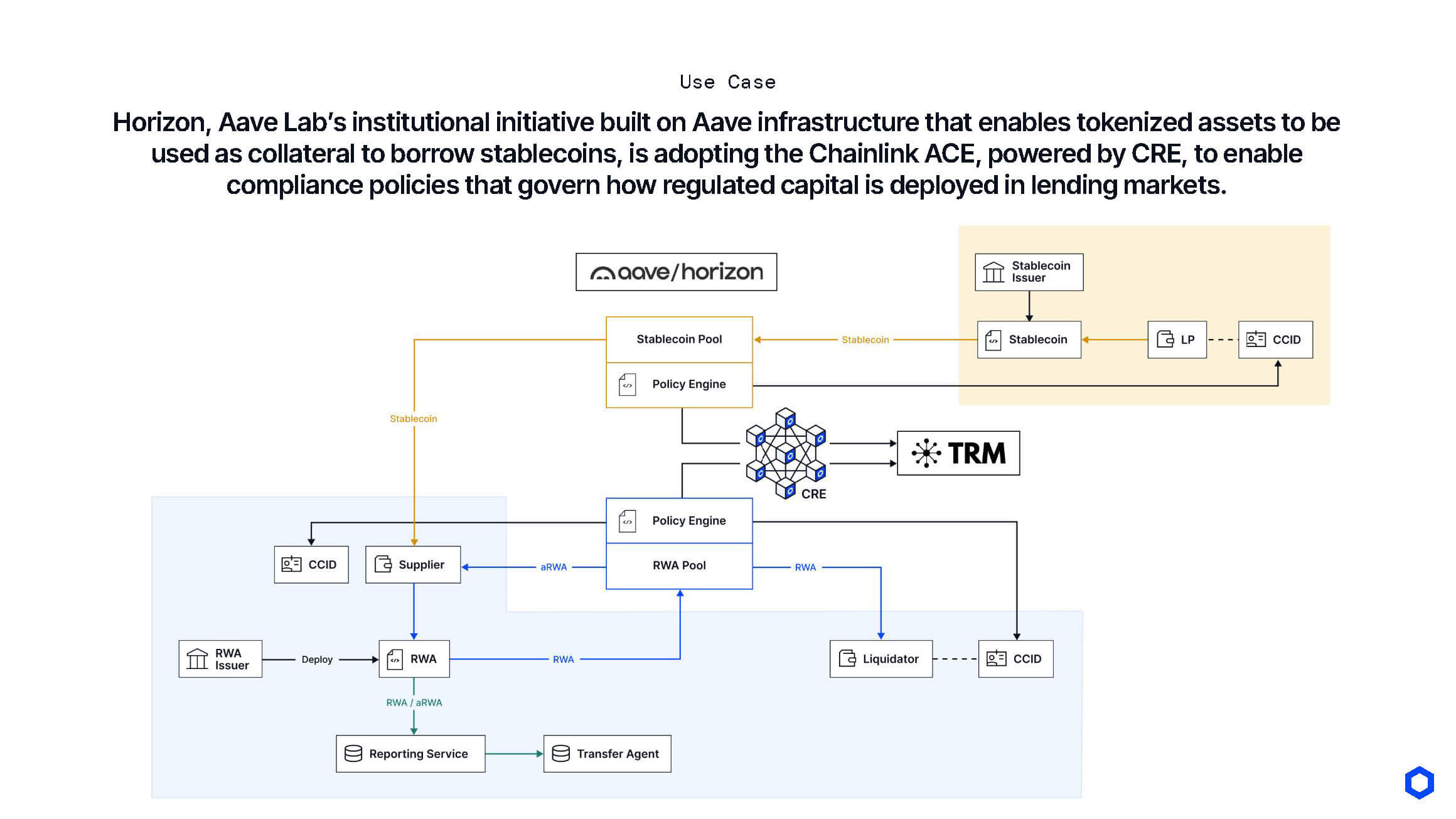
- Horizon, Aave Lab’s institutional initiative built on Aave infrastructure that enables tokenized assets to be used as collateral to borrow stablecoins, is adopting the Chainlink ACE, powered by CRE, to enable compliance policies that govern how regulated capital is deployed in lending markets.
- Kiln, a leading institutional onchain asset and yield management platform with over $18 billion in assets delegated, is building a new generation of onchain yield products on CRE, empowering users to manage liquidity across vaults through programmatic yield strategies.
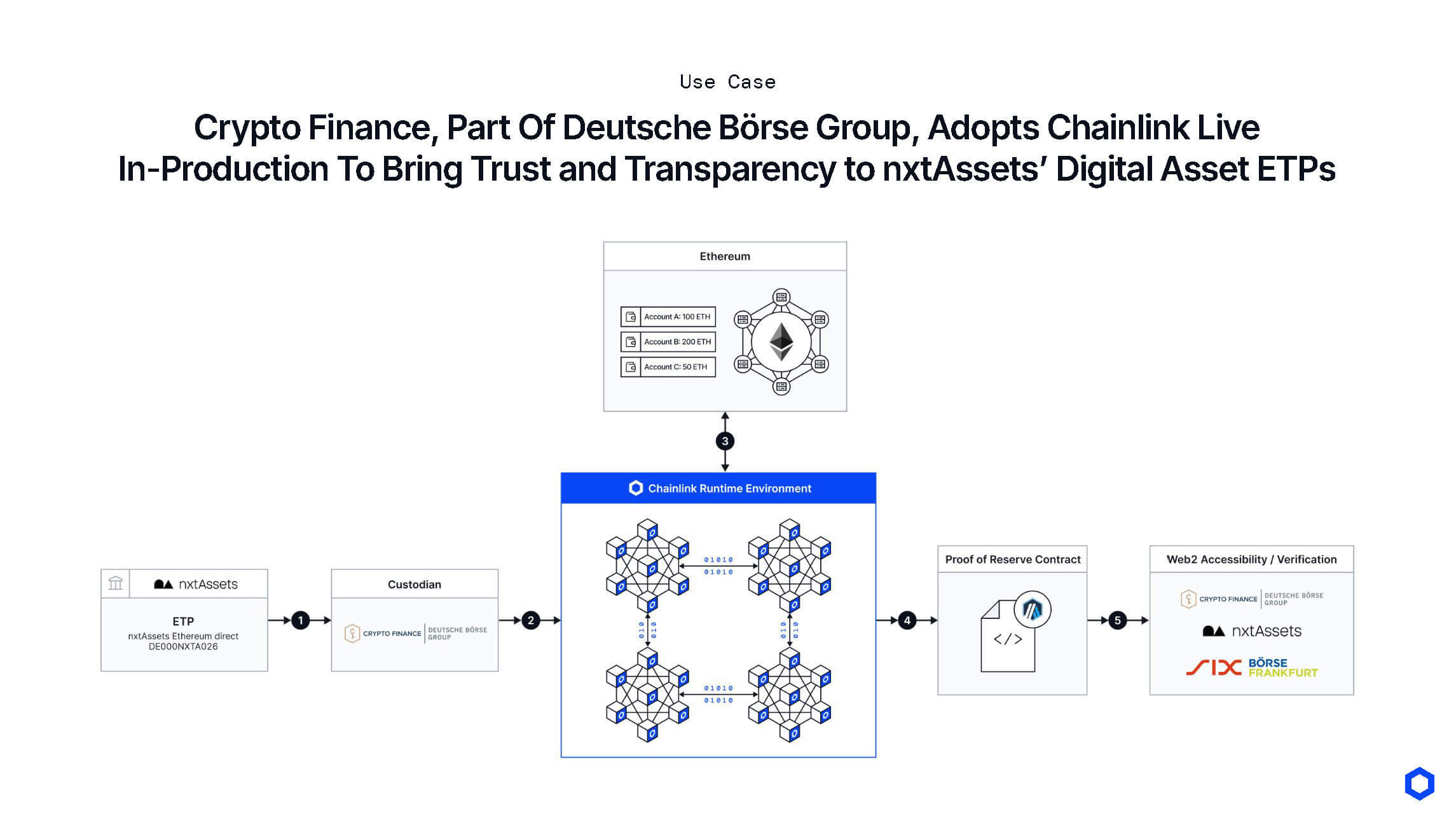
- Crypto Finance by Deutsche Börse Group leveraged CRE to orchestrate a Proof of Reserve feed for onchain verification of assets held in custody by Crypto Finance, supporting its physically backed Ethereum and Bitcoin ETPs.
- Enzyme is integrating CRE to advance institutional tokenized product administration by enabling Onyx users to streamline net asset value (NAV) and reporting processes across networks and data sources.
- PSG Digital adopted CRE for NAV calculations and Proof of Reserve to support near real-time reserves verification of its tokenized financial products, as well as the Automated Compliance Engine (ACE) for seamless compliance.
- Many more: Misyon Bank, Pairpoint (Vodafone and Sumitomo joint venture), and LlamaRisk are using CRE to orchestrate the connection of key data onchain—from price feeds and proof of reserves to telco tower usage, and risk-adjusted pricing for tokenized RWAs—while many top Web3 protocols are also integrating CRE, including BridgeTower, Aerodrome, Stake.Link, Concero, Instruxi, and Quantamm.
Ready to capture the $867 trillion tokenization opportunity? If you’re a developer, you can start building on CRE today. If you’re an institution ready to deploy, reach out to us.
Smart Contracts Are Becoming Increasingly More Advanced
Traditional Finance (TradFi) is rapidly moving onchain to realize increased efficiencies, higher yields, and new markets, with smart contracts and tokenized real-world assets (RWAs) being the foundation of a more composable, accessible, and automated global financial system. The Boston Consulting Group projects ~$16 trillion in tokenized illiquid assets by 2030—approximately 10% of global GDP—while the World Economic Forum estimates that tokenization could target up to $867 trillion in financial assets, representing nearly all global assets. Settlements and payments involving these assets amount to hundreds of trillions in value, much of which can be replatformed by onchain rails.
As institutions increasingly adopt blockchains for the tokenization of RWAs, they require institutional-grade smart contracts that go above and beyond what blockchain execution environments alone can provide. Institutional-grade smart contracts require access to external data, such as underlying asset prices, net asset values (NAVs), assets under management (AUM), and proof of reserves. They need to seamlessly interoperate across the hundreds of public and private blockchains that now issue tokenized RWAs and list the stablecoins, tokenized deposits, and CBDCs that are used to buy digital assets issued by institutions. They also need built-in compliance policies, privacy for internal and regulatory requirements, and direct communication to/from all of the existing core banking and financial infrastructure that currently powers the global financial system.
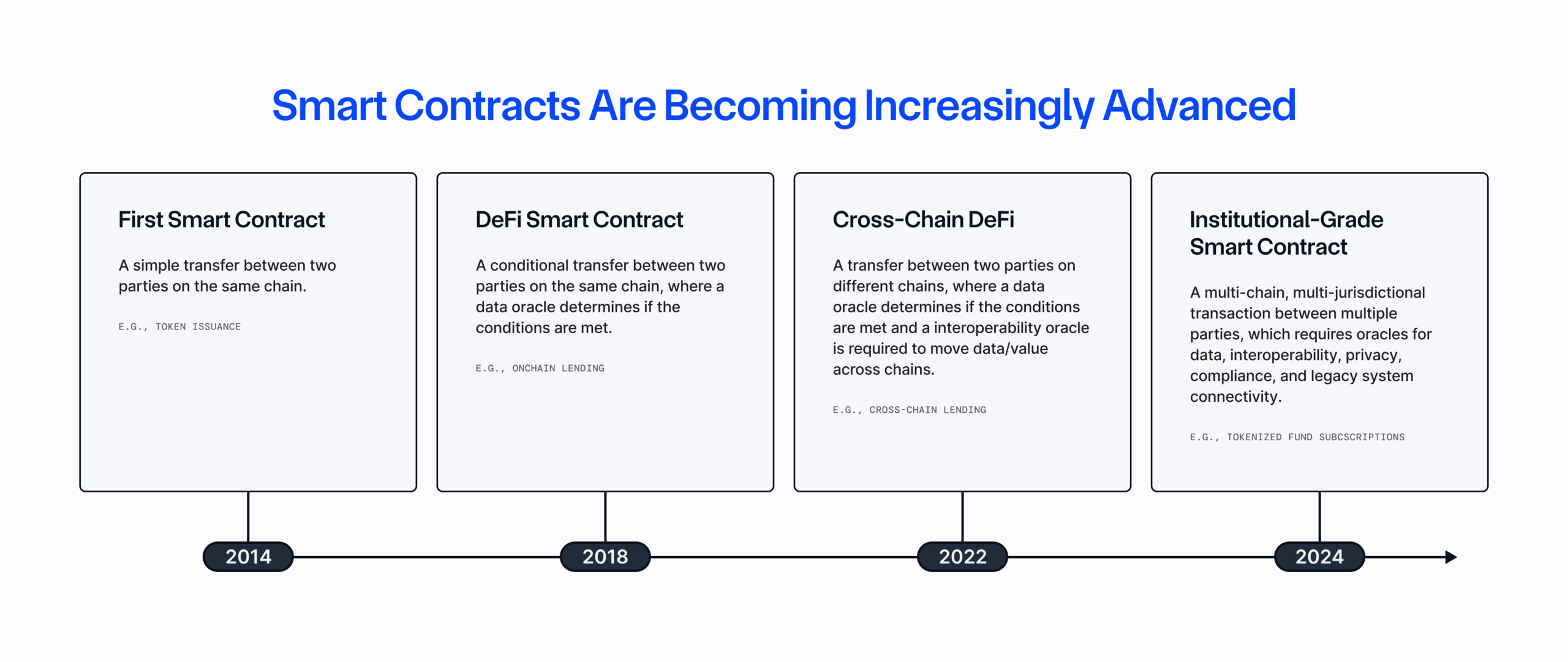
This increase in complexity is a natural result of institutional adoption, and is necessary for the blockchain industry to go from a few trillion in value to hundreds of trillions. Not only do financial institutions have these new smart contract requirements, but Decentralized Finance (DeFi) does too if they want access to TradFi’s billions of users and hundreds of trillions in liquidity. DeFi has a great opportunity to service TradFi by providing superior yields and new efficiency gains, but only if they build institutional-grade smart contracts that meet a wider range of requirements.
This newfound, but necessary, complexity has made it increasingly time-consuming and resource-intensive to build smart contracts. Solving all their requirements in-house is simply not a feasible option anymore. And managing a growing list of third-party vendors adds even more complexity and risk, especially given the hundreds of different interfaces, security assumptions, and economic models.
What the industry needs to scale is an all-in-one orchestration layer that simplifies the launch and operation of institutional-grade smart contracts. That’s exactly what CRE is built to provide.
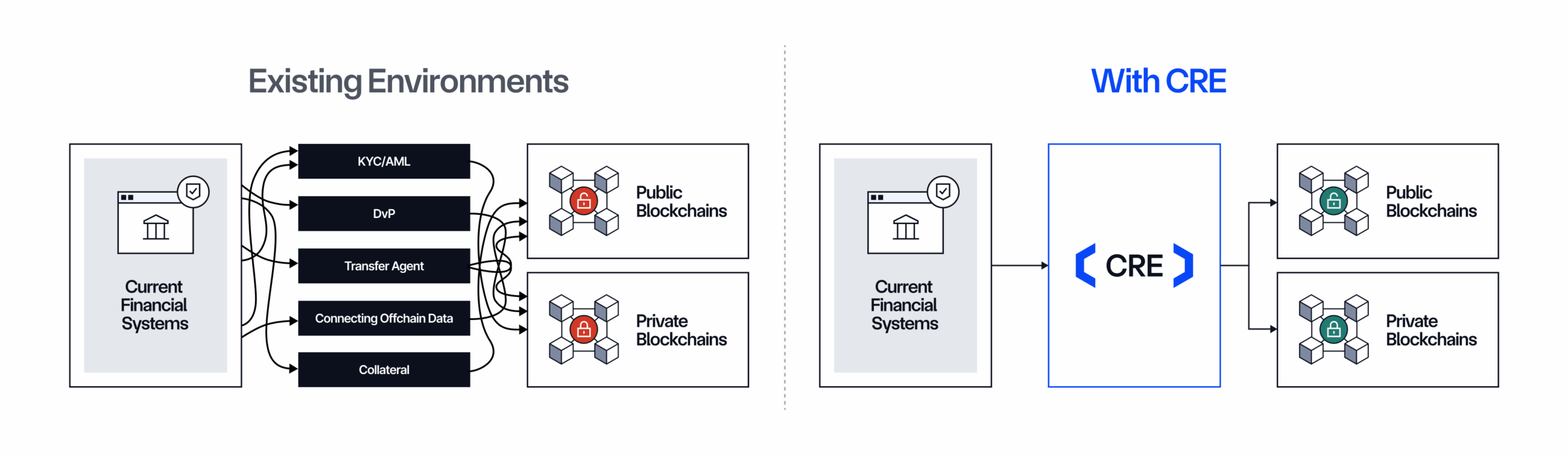
Similar to how Chainlink Data Feeds supercharged DeFi ecosystems, CRE is now supercharging institutional adoption and tokenized RWAs in blockchain ecosystems. CRE makes it simple for institutions to get connected and start interacting onchain with DeFi applications and tokenized assets while still meeting their institutional requirements. This abstraction of complexity enabled by CRE leads to more assets being issued onchain, more liquidity being deployed onchain, and ultimately more onchain transaction volume to the benefit of all blockchain ecosystems connected to CRE. The result is a more streamlined pipeline between TradFi capital and DeFi ecosystems, bringing exponentially more value into the industry as a whole.
CRE: The Orchestration Layer of Onchain Finance
CRE is the start of a new era in onchain development. It provides:
- All-in-one orchestration layer: CRE connects blockchains, data providers, and enterprise systems into one interoperable environment. This condenses all your orchestration code into a single execution environment, enabling complex cross-chain, multi-system operations to be deployed in days not months.
- Blockchain abstraction: Instead of integrating every chain and managing low-level blockchain logic or gas tokens, simply write your institutional-grade smart contract logic and let CRE handle all of the orchestration and execution. This radically streamlines the costs and resources needed to build more advanced smart contracts.
- Compliance and privacy-ready architecture: CRE enables automated compliance, private smart contracts, policy management, identity verification, auditability, and privacy of sensitive data and logic. This allows regulated entities to scale securely without disrupting existing compliance processes and privacy requirements.
- Verifiable execution and enterprise-grade security: CRE provides verifiable execution that proves every step occurred as defined. It’s also backed by infrastructure that’s already enabled tens of trillions in transaction value and currently secures nearly $100 billion. This gives institutions real-time visibility and integrity assurance across multi-chain operations, along with provably resilient security, even during the most volatile market conditions.
- Integrated stack: CRE unifies all of Chainlink’s standards and services across data, cross-chain interoperability, compliance, and privacy into a single environment. Where others solve half or just one part of the problem, CRE solves all your onchain requirements.

Institutional Use Cases Being Built on CRE Today
CRE is already being adopted by the world’s largest financial institutions and market infrastructures to power onchain finance use cases, including:
- Advanced Tokenized Assets: Use CRE as key infrastructure underpinning critical functions of your stablecoins and tokenized assets. This includes cross-chain interoperability, data oracles, compliance enforcement, and more.
- Cross-Chain Liquidity and Collateral: Coordinate cross-chain and onchain/offchain transactions using CRE. This includes cross-chain Delivery vs. Payment and Payment vs. Payment, as well as hybrid settlement setups where one leg of the transaction is onchain and the other is offchain.
- Onchain Data Distribution: Bring critical data onchain needed to service tokenized assets or facilitate transactions through CRE. This includes forex prices, NAVs, AUMs, and virtually any other data.
- Private Smart Contracts: Leverage CRE’s privacy capabilities to protect sensitive data and business logic within and across chains. This includes proprietary data delivery, confidential asset transfers, and privacy-preserving compliance.




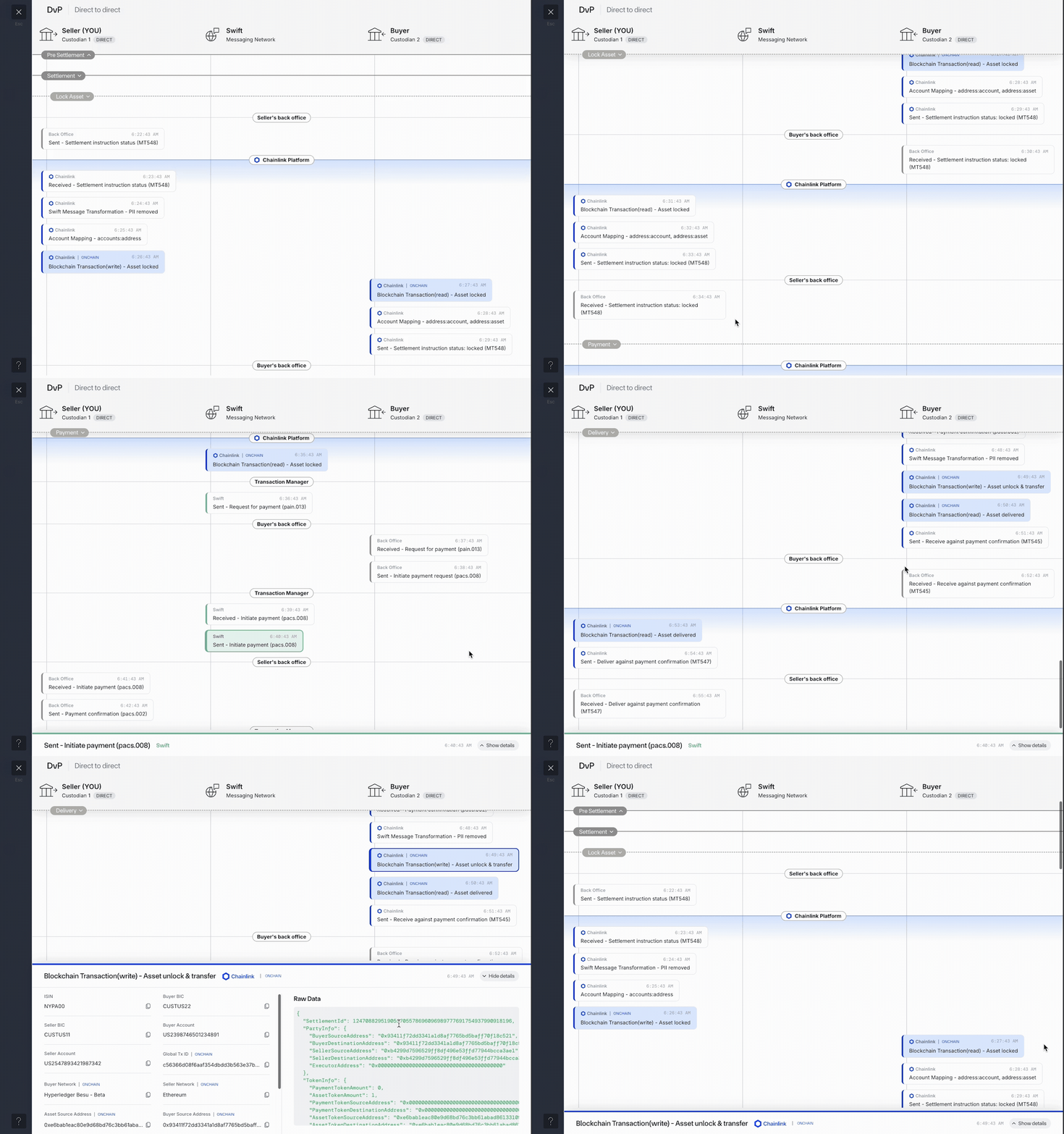
Example: Using CRE to trigger onchain transactions using existing financial messaging standards, such as Swift
CRE empowers institutions to use existing financial messaging standards. In 2024, Chainlink showed how CRE can connect to the Swift network to initiate blockchain transactions that meet their compliance requirements, showing how a distributor can use their existing Swift messaging infrastructure to trigger subscription or redemption requests for tokenized funds on any blockchain.
Once the request is executed, CRE translates the resulting onchain events back into Swift messages, enabling distributors to maintain end-to-end interoperability with their existing systems and counterparties. This approach allows institutions to securely interact with multiple blockchains while preserving their current infrastructure, operational workflows, and regulatory processes.
Developers Can Get Started In Minutes
CRE offers powerful tools for developers to seamlessly coordinate their external data, cross-chain interoperability, identity and compliance solutions, and connectivity to existing systems into a single workflow or set of workflows.
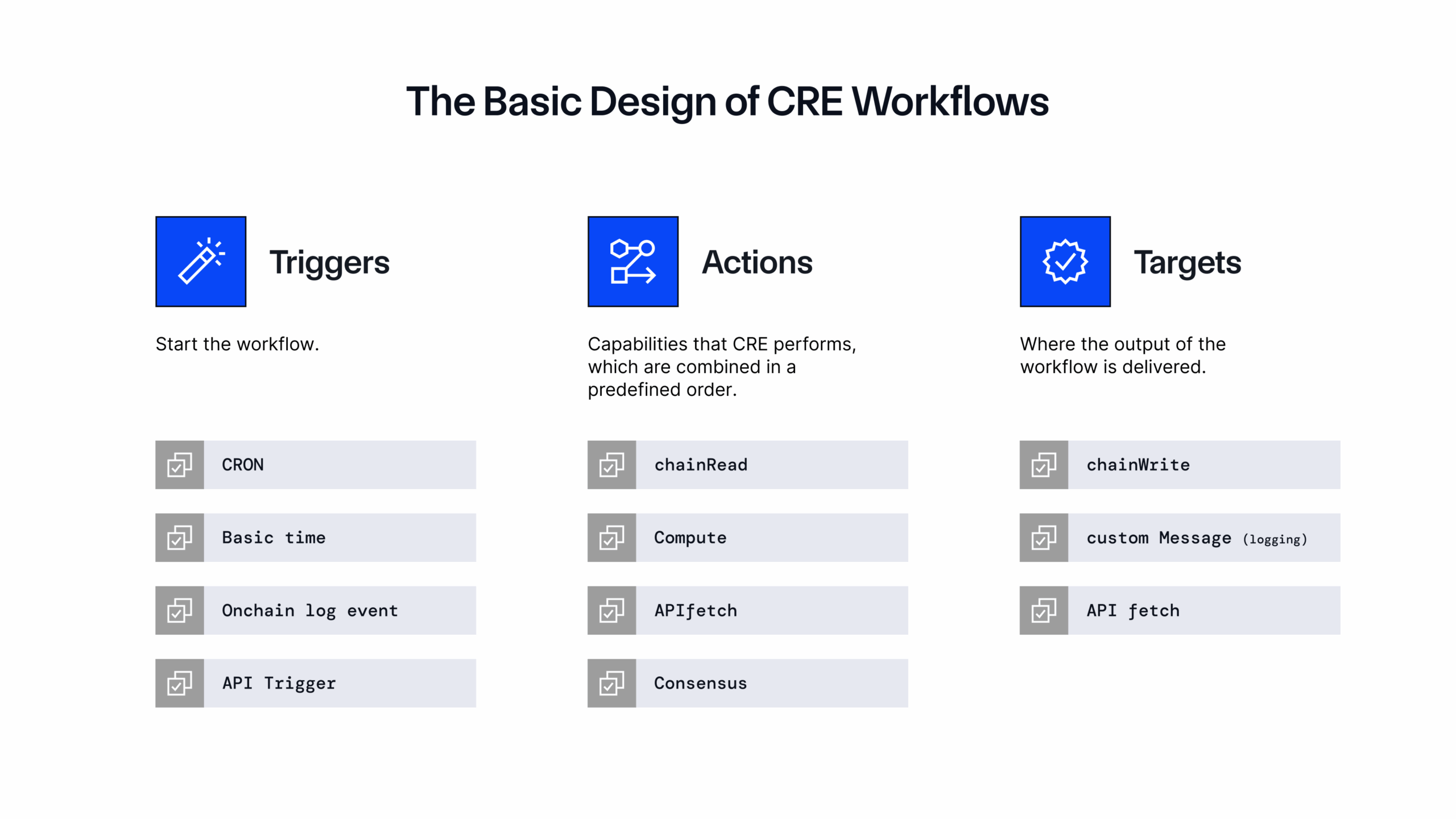
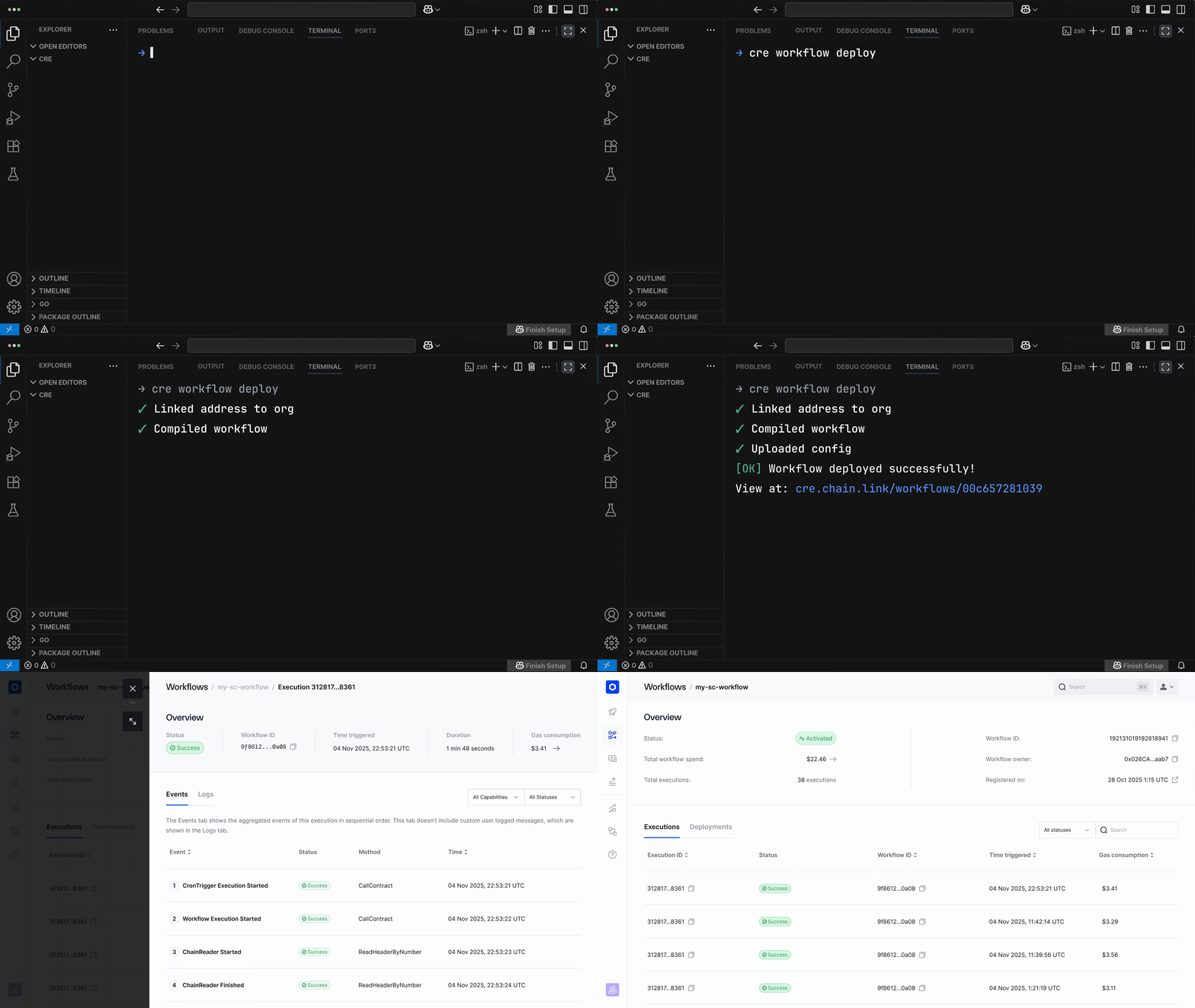
Developers can start writing their own workflows today in minutes using powerful dev tooling for designing, simulating, and deploying workflows without needing to manage custom infrastructure. This includes a Go SDK, Typescript SDK, CLI, pre-built use case templates, and a web interface. These developer tools provide a fast and easy way to build workflows quickly without wasting developer time worrying about everything. For example, you can use the CRE SDK to write data to a blockchain with guaranteed execution with 90% less code than before.
Check out the developer docs to get started and explore our use cases blog for examples that you can compile and run today.
Developers can also use the new Chainlink Developer Assistant MCP Server to access documentation, code samples, and configuration data for CRE, CCIP, and Data Feeds directly through their AI-enabled Integrated Development Environment (IDE). This makes it faster than ever to build CRE workflows for cross-chain and data feeds with the Chainlink platform.
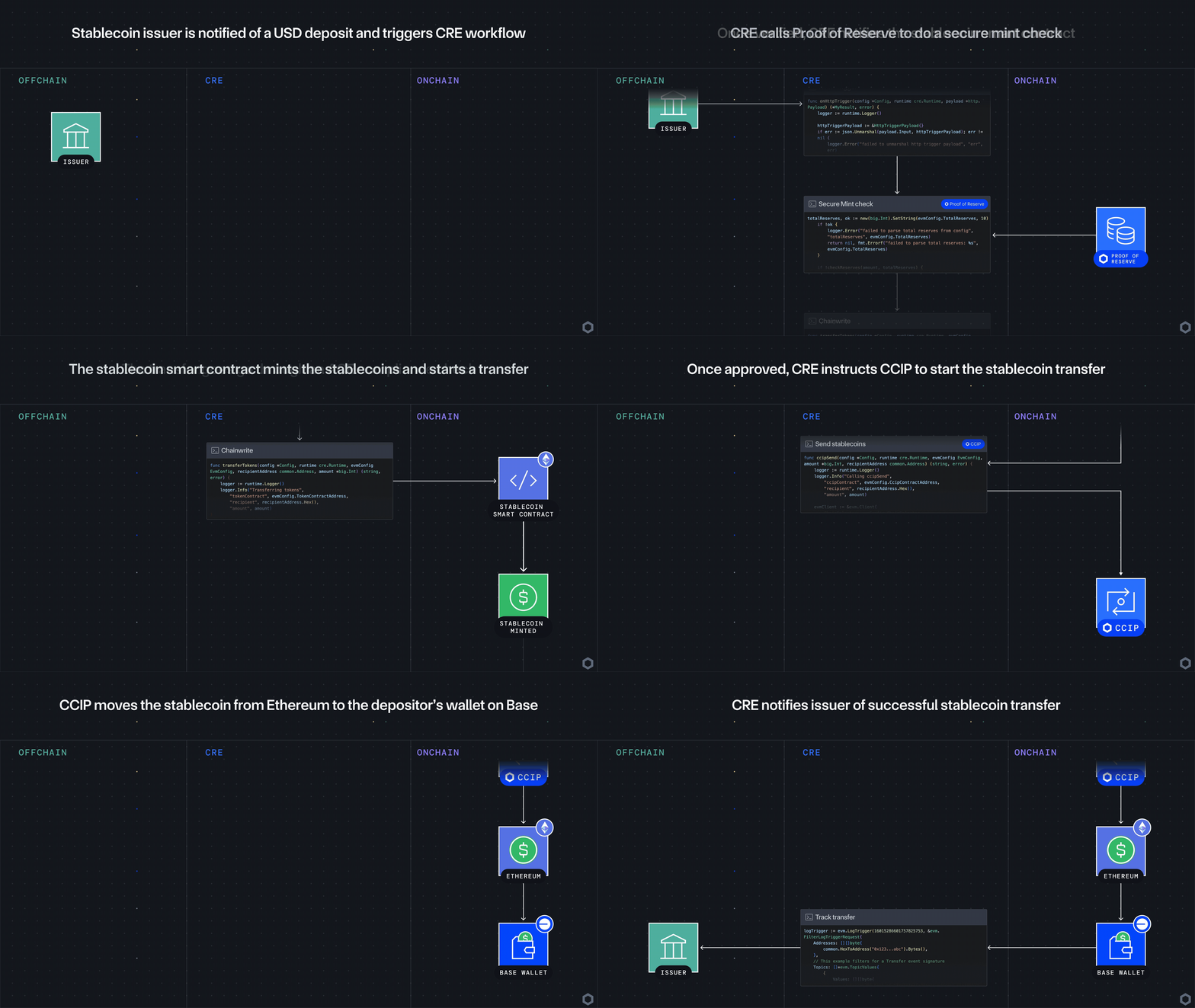
CRE can be leveraged to power advanced workflows that combine multiple Chainlink services across data, cross-chain interoperability, compliance, and external system connectivity. For instance, the workflow below shows how to issue a stablecoin to a depositor on another blockchain:
- The stablecoin issuer triggers the start of a CRE workflow, which begins by calling Chainlink Proof of Reserve for external data needed to do a secure mint check (i.e., the minting of new stablecoins onchain, but only once it’s been verified that there is sufficient reserves held offchain in a bank or on another blockchain).
- Once the reserves are verified using Proof of Reserve data, the CRE workflow is triggered from the onchain event and subsequently triggers a mint in the stablecoin smart contract.
- The stablecoin smart contract then mints the new stablecoins. But before sending the stablecoins to the depositor, it checks with the Automated Compliance Engine (ACE) to verify that the depositor’s address is not blacklisted (onchain).
- Once approved, CRE calls Chainlink Cross-Chain Interoperability Protocol (CCIP) to transfer the funds cross-chain to the depositor‘s address on another blockchain network.
- CRE notifies the issuer that the transfer has been completed.
Once a CRE workflow is created, it can be made extensible to support new use cases or it can be reused by the open-source community. This creates a network effect: the more workflows that are adopted as a standard way to operate an institutional smart contract and the more chains and existing systems that are integrated with CRE, the more efficient it becomes to launch institutional smart contracts across these chains and systems.
Some more powerful ways to leverage CRE include:
- Power Multi-Chain DeFi Protocols: Support seamless cross-chain operations, such as token transfers, governance votes, and liquidity rebalancing.
- Connect to Custom Offchain Data: Just fund your account, get the API keys, and get permissioned for access onchain.
- Build Custom Oracles & Compute: Automate event-based actions, risk modeling, and financial analytics.
- Enable OnChainReads + Compute: Query and analyze onchain data across multiple networks or calculate system-wide metrics like global supply and liquidity insights.
- Build Institutional-Grade Smart Contracts: Combine offchain logic with onchain execution to automate workflows, such as synchronization of liquidity, collateral, and risk strategies across chains.
The Next Chapter for CRE and Onchain Finance
CRE is set to massively accelerate the growth of the blockchain industry by enabling global institutions to come onchain. This wave of adoption benefits blockchains, developers, and DeFi protocols alike by accelerating the movement of the world’s value onchain and enabling new tokenized asset use cases, with all economic activity orchestrated securely and verifiably through CRE. Just as Chainlink catalyzed the growth of DeFi when the industry was new and unproven, CRE will do the same for the entire blockchain economy by making it seamless to build and scale institutional-grade smart contracts.
Privacy is critical to the success of onchain finance. For the blockchain industry to scale to hundreds of millions of users and the institutions that serve them, the industry needs an easy-to-use privacy solution. That’s why we’re making Chainlink Confidential Compute natively accessible as a key feature of future CRE workflows. Chainlink Confidential Compute is a breakthrough privacy service on CRE that unlocks a new class of private smart contracts that connect to real-world financial data and Web2 systems and interoperate across blockchains while keeping proprietary data, business logic, external connectivity, and computation fully confidential. This unlocks new, previously impossible onchain use cases for institutions, including private transactions, privacy-preserving tokenization, confidential data distribution, privacy-preserving cross-chain interoperability, privacy-preserving identity/compliance, and much more.
To learn more, read the blog: Chainlink Confidential Compute: Unlocking Private Smart Contracts on Any Blockchain. To build with Chainlink Confidential Compute, sign up for Early Access now.
Start Building With CRE Today
Select projects are already live on mainnet with CRE across multiple blockchains, with more blockchains being actively integrated and developers now being gradually onboarded to deploy workflows.
Sign up to start building with CRE today. You can also learn more about CRE by reading the developer docs, or you can contact us to talk about your specific use cases.
—
Disclaimer: This post is for informational purposes only and contains statements about the future, including anticipated product features, development, and timelines for the rollout of these features. These statements are only predictions and reflect current beliefs and expectations with respect to future events; they are based on assumptions and are subject to risk, uncertainties, and changes at any time. There can be no assurance that actual results will not differ materially from those expressed in these statements, although we believe them to be based on reasonable assumptions. All statements are valid only as of the date first posted. These statements may not reflect future developments due to user feedback or later events and we may not update this post in response. Please review the Chainlink Terms of Service, which provides important information and disclosures.


